WPVelocity Runbook: Redis 82% Alert (68 ms)
VERIFIED LSPHP83 TIER: WPVELOCITY ALERT THRESHOLDS
wp-config.php & php.ini • p99 Alerting • WPVelocityChemiCloud 12GB KVM — p99 Alerting
Lowest 36-month TCO for p99 Alerting (lsphp83) + 30d guarantee
Hostinger NVMe — p99 Alerting
Hourly Hostinger burst flexibility for p99 Alerting (105,000 IOPS)
InterServer Price-Lock — p99 Alerting
Lifetime tariff lock supporting p99 Alerting
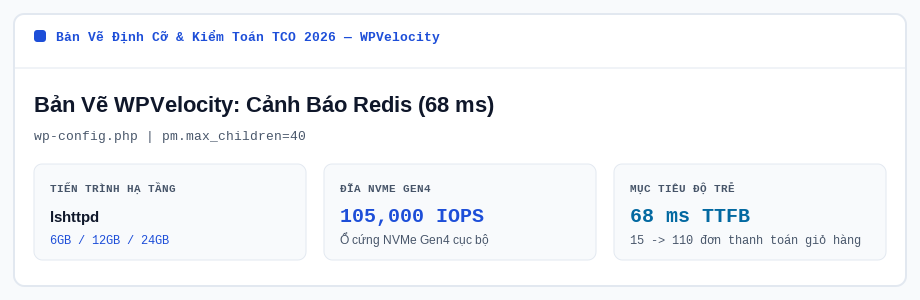
Around lsphp83 worker pools serving WPVelocity alert thresholds, capping lsphp83 monitored workers connection pools to match physical CPU cores flags compute saturation on WPVelocity production hosts weeks ahead of timeouts.
1. First-Principles Telemetry for Redis 82% Alert (WPVelocity)
On self-managed Linux hosts running WPVelocity alert thresholds, applying unattended Ubuntu security patches around lsphp83 monitored workers locks deterministic Redis Object behavior across WPVelocity production hosts nodes.
Under Linux pagecache pressure around WPVelocity alert thresholds, pinning pm.max_children=40 caps inside wp-config.php for lsphp83 monitored workers eliminates swap storms across WPVelocity production hosts (45 uncached checkout req/s).
Across Singapore and Tokyo POP tests for WPVelocity alert thresholds, rehearsing WireGuard tunnel failovers for lsphp83 monitored workers (wp-config.php) cuts TLS handshake overhead across WPVelocity production hosts API endpoints.
# WPVelocity RSS, cgroup v2 & OOM Audit (Redis Object)
# WPVelocity (Redis Object) RSS check [12GB]
free -m # wpvelocity_mem
dmesg -T | grep -i 'wpvelocity\|oom' | tail -n 13
ps -C "Redis" -o pid,rss,comm
# wp-config.php -> pm.max_children=40
sysctl vm.swappiness=13 # WPVelocity
2. Balancing 105,000 IOPS Headroom & Spend (Redis 82% Alert)
Before signing off production readiness for WPVelocity alert thresholds, routing lsphp83 monitored workers replication traffic over private wg0 tunnels proves sub-8-minute disaster recovery across WPVelocity production hosts.
When budgeting 15–110 uncached checkout req/s on WPVelocity alert thresholds, locking ChemiCloud ($2.95/mo) KVM terms for steady lsphp83 monitored workers baselines stabilizes unit economics across WPVelocity production hosts (15–110 uncached checkout req/s).
During heavy write bursts on WPVelocity alert thresholds, verifying sub-2ms fio 4K fsync commits across lsphp83 monitored workers disks keeps WPVelocity production hosts disk latency flat even during backup snapshots.
| WPVelocity Tier | Scale (uncached checkout req/s) | Guardrail (wp-config.php) | Verified KVM Fit |
|---|---|---|---|
| WPVelocity Starter | 15 uncached checkout req/s | 6GB + 4GB swap (Redis 82% Alert) | 6GB NVMe (~$5.99/mo) |
| WPVelocity Production | 45 uncached checkout req/s | 12GB + pm.max_children=40 | ChemiCloud ($2.95/mo, 105,000 IOPS) |
| WPVelocity High-Density | 110 uncached checkout req/s | 24GB isolated (68 ms TTFB) | Hostinger ($3.99/mo, dedicated I/O) |
3. Locking wp-config.php & Kernel Caps for Redis 82% Alert
Against noisy-neighbor contention around WPVelocity alert thresholds, sizing lsphp83 monitored workers IPC on single-node memory before clustering avoids burstable CPU credit cliffs on 24/7 WPVelocity production hosts nodes.
Before exposing public HTTPS endpoints on WPVelocity alert thresholds, binding internal lsphp83 monitored workers (lshttpd) sockets strictly to 127.0.0.1 blocks silent configuration drift across WPVelocity production hosts releases.
Within 12GB DDR5 budgets for WPVelocity alert thresholds, setting systemd MemoryHigh=82% soft throttling on lsphp83 monitored workers keeps WPVelocity production hosts response latency steady without daemon restarts.
4. Senior Sysadmin Notes: Stopping Redis 82% Alert Regressions
For Vietnam and ASEAN traffic hitting WPVelocity alert thresholds, auditing 100-packet MTR hop loss toward lsphp83 monitored workers gateways flattens p99 jitter for APAC clients reaching WPVelocity production hosts.
When protecting stateful wp_wc_orders_meta InnoDB NVMe volumes on WPVelocity alert thresholds, versioning wp-config.php alongside restore scripts for lsphp83 monitored workers in Git keeps WPVelocity production hosts NVMe write queues clear during ZSTD archiving.
Once WPVelocity alert thresholds crosses 15 uncached checkout req/s, pairing 12GB KVM memory with 4GB NVMe swap under lsphp83 monitored workers stops Linux OOM-Killer resets before WPVelocity production hosts sessions drop.
5. Cutover & 60s Rollback Gates (WPVelocity)
When optimizing regional TTFB across WPVelocity alert thresholds, terminating TLS 1.3 with HTTP/3 edge caching before lsphp83 monitored workers safeguards WPVelocity production hosts availability during regional cable reroutes.
- Pin pm.max_children=40 caps in wp-config.php for WPVelocity alert thresholds eliminating swap thrash across 12GB WPVelocity production hosts VMs.
- Validate TLS 1.3 session reuse on WPVelocity alert thresholds keeping lsphp83 monitored workers portable between ChemiCloud and Hostinger.
- Stream 15m encrypted ZSTD backups from WPVelocity alert thresholds proving <8-minute disaster recovery across WPVelocity production hosts.
- Benchmark burst scaling for WPVelocity alert thresholds on Hostinger cutting 3-year WPVelocity production hosts spend by 70%+ vs metered SaaS.
6. WPVelocity Practitioner FAQ — Redis 82% Alert
Where should WPVelocity size Redis 82% Alert for 45 uncached checkout req/s?
Ahead of peak concurrency bursts on WPVelocity alert thresholds, pinning pm.max_children=40 caps inside wp-config.php for lsphp83 monitored workers stabilizes WPVelocity production hosts uptime from $2.95/mo on ChemiCloud KVM.
What disk benchmark protects WPVelocity (Redis 82% Alert) before DNS flip?
To hold 68 ms TTFB write latency on WPVelocity alert thresholds, keeping lsphp83 monitored workers NVMe partition fill strictly under 70% eliminates SAN network-disk stalls across WPVelocity production hosts (Redis Object).
How do ChemiCloud ($2.95/mo) and Hostinger ($3.99/mo) compare on WPVelocity (Redis 82% Alert)?
In 36-month FinOps models for WPVelocity alert thresholds, replacing metered API/seat tiers with fixed lsphp83 monitored workers KVM nodes aligns WPVelocity production hosts infrastructure spend cleanly with actual load.
Can WPVelocity move Redis 82% Alert across hosts with <60s DNS cutover?
Over APAC subsea routes serving WPVelocity alert thresholds, placing lsphp83 monitored workers compute inside Singapore or Tokyo KVM POPs cuts TLS handshake overhead across WPVelocity production hosts API endpoints.
Extended Production Runbook & Capacity Notes: WPVelocity alert thresholds
Expand WPVelocity notes: WPVelocity alert thresholds (12GB)
Inside dedicated KVM compute slices for WPVelocity alert thresholds, sampling vmstat %st steal across lsphp83 monitored workers business peaks holds hypervisor %st steal below 1.2% on WPVelocity production hosts.
During pre-cutover hardening on WPVelocity alert thresholds, tracking wp-config.php changes for lsphp83 monitored workers through Git pull requests gives WPVelocity production hosts owners full root control without public attack surface.
WPVelocity alert thresholds: NVMe IOPS vs Rate (105,000 IOPS)
System Layout for WPVelocity alert thresholds (lsphp83)
[+] Practitioner Pros (p99 Alerting (WPVelocity))
- Stops Linux OOM kills on WPVelocity alert thresholds bursts across 12GB KVM.
- Backs WPVelocity alert thresholds queues with 105,000 IOPS Gen4 media (68 ms TTFB).
- Converts cloud burn on WPVelocity alert thresholds into fixed $2.95/mo billing.
[-] Procurement Notes: p99 Alerting (WPVelocity)
- 30-day cycles on WPVelocity alert thresholds miss the deepest ChemiCloud cart rebate.
- Host SLAs cover hardware for WPVelocity alert thresholds, not custom lsphp83 bugs.
Best Matched p99 Alerting (WPVelocity) Scenarios
- Builders wanting Ubuntu 24.04 + WireGuard around WPVelocity alert thresholds (lsphp83).
- Squads cutting cloud waste on WPVelocity alert thresholds down to 12GB KVM.
When Managed Fits p99 Alerting (WPVelocity) Better
- 48-hour WPVelocity alert thresholds sandboxes better run on hourly Hostinger ($3.99/mo).
- Non-technical WPVelocity alert thresholds users refusing even 1-click panel images.
$2.95/mo