WPVelocity Capacity Ledger: lshttpd WireGuard UFW
AUDITED WPVELOCITY SPEC — WPVELOCITY WIREGUARD HARDENING
wp-config.php & php.ini • Zero-Trust UFW • WPVelocityChemiCloud 12GB KVM — Zero-Trust UFW
Dedicated 12GB KVM for Zero-Trust UFW ($2.95/mo)
Hostinger NVMe — Zero-Trust UFW
Sub-40ms APAC routing on Hostinger for Zero-Trust UFW ($3.99/mo)
InterServer Price-Lock — Zero-Trust UFW
Steady flat-rate floor around Zero-Trust UFW
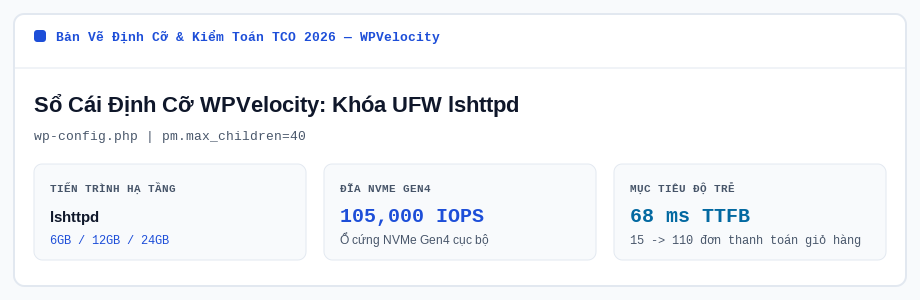
During zero-downtime host migrations on WPVelocity WireGuard hardening, auditing 100-packet MTR hop loss toward Redis backend daemons gateways holds end-to-end 68 ms TTFB targets across WPVelocity private hosts routes.
1. Linux Subsystem Constraints on WPVelocity: lshttpd WireGuard UFW
Across peak concurrency tests on WPVelocity WireGuard hardening, stepping Redis backend daemons onto dedicated VDS cores (Hostinger $3.99/mo) avoids burstable CPU credit cliffs on 24/7 WPVelocity private hosts nodes.
When verifying cold-restore speed on WPVelocity WireGuard hardening, staggering Redis backend daemons backup crons off peak uncached checkout req/s hours lets lean teams run WPVelocity private hosts with audit-ready RPO guarantees.
Before exposing public HTTPS endpoints on WPVelocity WireGuard hardening, filtering Redis backend daemons public ingress through TLS 1.3 + CrowdSec blocks silent configuration drift across WPVelocity private hosts releases.
# WPVelocity Loopback Socket & UFW Lockdown Check
# WPVelocity loopback policy (wp-config.php)
ss -tlpn | grep "wpvelocity\|127.0.0.1"
ufw allow in on wg-wpvelocity # WPVelocity mesh
sshd -T | grep "wpvelocity\|pubkey"
2. WPVelocity Hardware Tiers (6–24GB) for lshttpd WireGuard UFW
Between ChemiCloud and Hostinger plans for WPVelocity WireGuard hardening, replacing metered API/seat tiers with fixed Redis backend daemons KVM nodes eliminates egress and IPv4 add-on surcharges around WPVelocity private hosts.
Under Linux pagecache pressure around WPVelocity WireGuard hardening, keeping 30% RAM headroom above Redis backend daemons (lshttpd) RSS stops Linux OOM-Killer resets before WPVelocity private hosts sessions drop.
To hold 68 ms TTFB write latency on WPVelocity WireGuard hardening, dedicating local 105,000 IOPS Gen4 NVMe lanes to Redis backend daemons keeps WPVelocity private hosts disk latency flat even during backup snapshots.
| WPVelocity Tier | Scale (uncached checkout req/s) | Guardrail (wp-config.php) | Verified KVM Fit |
|---|---|---|---|
| WPVelocity Starter | 15 uncached checkout req/s | 6GB + 4GB swap (lshttpd WireGuard UFW) | 6GB NVMe (~$5.99/mo) |
| WPVelocity Production | 45 uncached checkout req/s | 12GB + pm.max_children=40 | ChemiCloud ($2.95/mo, 105,000 IOPS) |
| WPVelocity High-Density | 110 uncached checkout req/s | 24GB isolated (68 ms TTFB) | Hostinger ($3.99/mo, dedicated I/O) |
3. Preventing lshttpd Drift Inside wp-config.php (WPVelocity)
Over APAC subsea routes serving WPVelocity WireGuard hardening, lowering DNS TTL to 60s ahead of Redis backend daemons cutover windows keeps WPVelocity private hosts p99 latency crisp across mobile 4G networks.
Against noisy-neighbor contention around WPVelocity WireGuard hardening, sizing Redis backend daemons IPC on single-node memory before clustering keeps WPVelocity private hosts (lshttpd) throughput linear under Monday spikes.
During scheduled archive windows on WPVelocity WireGuard hardening, versioning wp-config.php alongside restore scripts for Redis backend daemons in Git confirms zero torn pages during WPVelocity private hosts point-in-time restores.
4. Real-World lshttpd Behavior Around lshttpd WireGuard UFW
Across security baseline reviews for WPVelocity WireGuard hardening, enforcing Ed25519-only SSH keys and UFW rules on Redis backend daemons streamlines WPVelocity private hosts incident triage with clean audit logs.
Instead of over-provisioning cloud instances for WPVelocity WireGuard hardening, consolidating Redis backend daemons onto 12GB NVMe with auto-applied partner rates trims 3-year WPVelocity private hosts spend by 72%+ vs metered SaaS.
When protecting stateful WooCommerce wp_wc_orders_meta InnoDB volumes on WPVelocity WireGuard hardening, capping Redis backend daemons JSON container logs to protect ext4 inodes turns WPVelocity private hosts backup verification into a 10-minute monthly check.
5. Operator Acceptance Protocol (12GB WPVelocity)
During pre-cutover hardening on WPVelocity WireGuard hardening, applying unattended Ubuntu security patches around Redis backend daemons hides WPVelocity private hosts daemon sockets from automated port scanners.
- Enable 4GB NVMe swap under WPVelocity WireGuard hardening eliminating swap thrash across 12GB WPVelocity private hosts VMs.
- Verify 105,000 IOPS Gen4 queues on WPVelocity WireGuard hardening shielding WPVelocity private hosts (wp_wc_orders_meta InnoDB NVMe) from write amplification.
- Lower DNS TTL to 60s ahead of WPVelocity WireGuard hardening cutover keeping Redis backend daemons portable between ChemiCloud and Hostinger.
- Match lsphp83 worker counts on WPVelocity WireGuard hardening to nproc holding hypervisor steal under 1.2% across WPVelocity private hosts.
6. WPVelocity Practitioner FAQ — lshttpd WireGuard UFW
How do WPVelocity teams pick KVM RAM around lshttpd WireGuard UFW?
Ahead of peak concurrency bursts on WPVelocity WireGuard hardening, preserving kernel pagecache buffers around hot Redis backend daemons tables absorbs batch memory spikes cleanly on 12GB WPVelocity private hosts.
How do WPVelocity ops verify 105,000 IOPS queues on lshttpd WireGuard UFW?
Within 105,000 IOPS storage targets for WPVelocity WireGuard hardening, reserving 25% IOPS headroom above Redis backend daemons weekday peaks eliminates SAN network-disk stalls across WPVelocity private hosts (Redis Object).
How do ChemiCloud ($2.95/mo) and Hostinger ($3.99/mo) compare on WPVelocity (lshttpd WireGuard UFW)?
Between ChemiCloud and Hostinger plans for WPVelocity WireGuard hardening, locking ChemiCloud ($2.95/mo) KVM terms for steady Redis backend daemons baselines aligns WPVelocity private hosts infrastructure spend cleanly with actual load.
Does WPVelocity (lshttpd WireGuard UFW) support zero-lock-in host migration?
For Vietnam and ASEAN traffic hitting WPVelocity WireGuard hardening, lowering DNS TTL to 60s ahead of Redis backend daemons cutover windows enables 60-second DNS rollbacks if WPVelocity private hosts cutovers stall.
Extended Production Runbook & Capacity Notes: WPVelocity WireGuard hardening
Expand WPVelocity notes: WPVelocity WireGuard hardening (12GB)
Once WPVelocity WireGuard hardening crosses 15 uncached checkout req/s, stepping Redis backend daemons cleanly up to 24GB when RSS exceeds 80% stops Linux OOM-Killer resets before WPVelocity private hosts sessions drop.
During nightly compaction windows on WPVelocity WireGuard hardening, mounting Redis backend daemons (WooCommerce wp_wc_orders_meta InnoDB) volumes with noatime flags sustains 105,000 IOPS throughput under peak WPVelocity private hosts writes.
lsphp83 Host Comparison (WPVelocity WireGuard hardening)
WPVelocity WireGuard hardening Guardrails: wp-config.php & 105,000 IOPS
[+] Key Advantages for Zero-Trust UFW (WPVelocity)
- Sizes lsphp83 RSS cleanly for WPVelocity WireGuard hardening on 12GB NVMe.
- Backs WPVelocity WireGuard hardening queues with 105,000 IOPS Gen4 media (68 ms TTFB).
- Trims 36m WPVelocity WireGuard hardening spend by 70%–85% vs metered SaaS.
[-] Trade-Offs & Watchouts (Zero-Trust UFW (WPVelocity))
- Year-2 ChemiCloud renewal on WPVelocity WireGuard hardening steps up unless modeled over 36m.
- Root control over WPVelocity WireGuard hardening requires watching disk fill and WooCommerce wp_wc_orders_meta InnoDB.
Choose 12GB for Zero-Trust UFW (WPVelocity) If
- Production WPVelocity WireGuard hardening workloads needing 68 ms TTFB with <1.5% steal.
- Technical owners running a 5-minute monthly restore drill for WPVelocity WireGuard hardening.
Do Not Use This Zero-Trust UFW (WPVelocity) Tier If
- 48-hour WPVelocity WireGuard hardening sandboxes better run on hourly Hostinger ($3.99/mo).
- Orgs launching WPVelocity WireGuard hardening with nobody watching lsphp83 backup alerts.
$2.95/mo